The Glide Tree
We have defined the glide for a given odd number as the sequence of odd numbers we pass through until we come to a smaller odd number. If x¬0 is the starting number and x¬1 end, we have a mapping G(x¬0){RA}x¬1. x¬1 will always be less than x¬0 (except when x¬0 is 1, or if some other loop is found). So if we iterate x¬[n+1]=G(x¬n) we will eventually arrive at 1.
We can join the individual hops G(x¬a){RA}x¬b into a tree, with the root at 1 (click for a larget version).
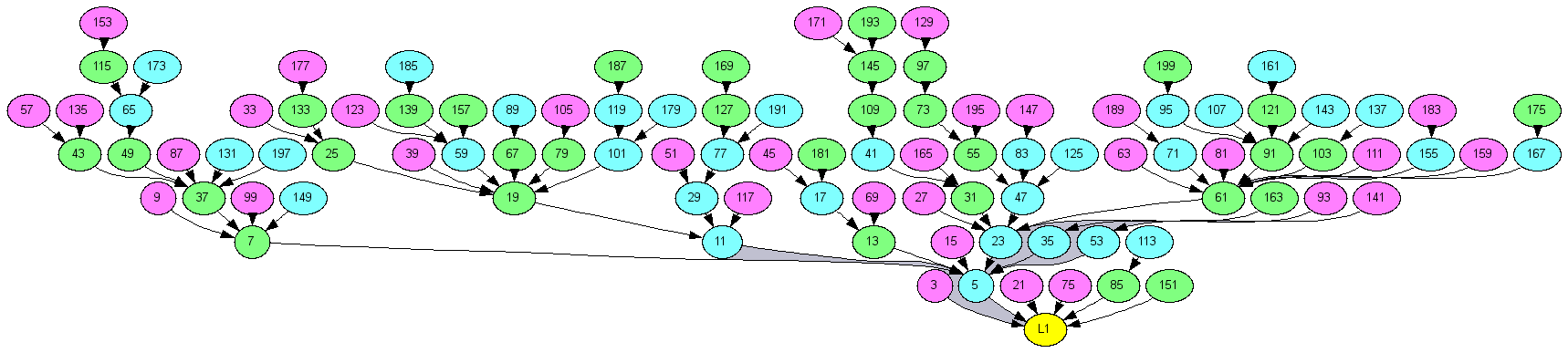
The nodes are coloured, blue=6k+5, green=6k+1, red=3k and yellow is the root. If we pick a number, say 167, we can perform the iteration and pick out the nodes in the glide tree:
175, 526, 263, 790, 395, 1186, 593, 1780, 890, 445, 1336, 668, 334, 167, 502, 251, 754, 377, 1132, 566, 283, 850, 425, 1276, 638, 319, 958, 479, 1438, 719, 2158, 1079, 3238, 1619, 4858, 2429, 7288, 3644, 1822, 911, 2734, 1367, 4102, 2051, 6154, 3077, 9232, 4616, 2308, 1154, 577, 1732, 866, 433, 1300, 650, 325, 976, 488, 244, 122, 61, 184, 92, 46, 23, 70, 35, 106, 53, 160, 80, 40, 20, 10, 5, 16, 8, 4, 2, 1
Glide Records
This illustration above shows the 3x+1 glide tree for odd numbers up to 199. We can use it to identify the following record holders.
| Seed Value | Glide Chain | Hops |
|---|---|---|
| 3 | 3, 1 | 1 |
| 7 | 7, 5, 1 | 2 |
| 9 | 9, 7, 5, 1 | 3 |
| 25 | 25, 19, 11, 5, 1 | 4 |
| 33 | 33, 25, 19, 11, 5, 1 | 5 |
| 97 | 97, 73, 55, 47, 23, 5, 1 | 6 |
| 129 | 129, 97, 73, 55, 47, 23, 5, 1 | 7 |
So far each record holder produces a chain one longer than the previous one.