Description
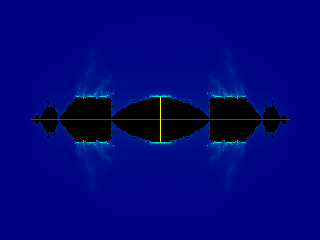
These 6 views are generated using the six different settings of the python script, ‑tA, ‑tB, ‑tC, ‑tD, ‑tM and ‑tJ. Each letter defines a plane where two of the 4 positional parameters (zx,xy,cx,cy) are kept fixed and two are varied. The Mandelbrot set exists in a plane where zx and zy are fixed and cx and cy are varied. The Mandelbrot image ('M' below) has been anotated to show the two C axes, cx (green) and cy (yellow).
The Julia sets exist on the planes where the values of cx and cy are fixed, and the initial Z value, (zx,zy) is allowed to vary. In the Julia image 'J' the zx axis is highlighted in red and the zy axis in magenta.
You can now see how the 6 planes intersect by matching up the corresponding coloured axes. The Julia and Mandelbrot planes have no common axis as in 4 dimensional space it is possible for two planes to intersect at a single point. In these examples, that point is (0,−1,0,0).
If you pick three axes and find the three views based on these axes you can imaging slotting them together and creating a 3‑dimensional slice of the 4D object. It is hard to imagine the whole 4D entity.
More on the nature of the 4D object can be found here.
The view at (0,0,−1,0)
 |
 |
| A | B |
 |
 |
| C | D |
 |
 |
| M | J |
Other pages
(c) John Whitehouse 2010 - 2023